An exploration of sculpture’s relationship to landscape and the body as viewed through the lens of the artist-traveler.


Our workshop will examine the notion of travel through such examples as Baudelaire’s flâneur, the Situationists’ theory of Psychogeography, and artists ranging from Robert Smithson and Richard Long, to Francis Alys and Olaf Breuning. We will conduct a series of exercises, expeditions, and missions including the creation of livable shelter-sculptures to inhabit on a weekend camping trip in the Scottish Highlands. Bedouin tents, arctic research stations, camper vans, Hoovervilles, hunting blinds, and interplanetary spacecraft serve as our inspirational points of departure...


Participants:

Matt King (Instructor), Andrew Cobb, Zoe Golden, Rebecca Henderson, Elise Isom, Mitchell Petersen, Cameron Robinson, Andrew Schmidt, Emily Stokes


The Glasgow Artists and Writers Workshop

Virginia Commonwealth University

Glasgow, Scotland, June 22nd - July 23rd, 2010

Thursday, July 15, 2010

The artists we talked about who viewed walking as art reminded me of the sacred labyrinths I saw last summer at a monastery in Prague.
They come in three basic designs- seven-circuit, eleven-circuit, and twelve-circuit.


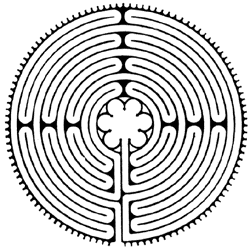
Labyrinths have been around for over 4000 years, and have been found in Native American, Greek, Celtic, and Mayan cultures. During the Crusades they were used to symbolize the path to salvation, while some cultures used them to symbolize the Earth. Unlike mazes, which have many dead ends and are meant to trick the person walking through them, labyrinths have only one path to walk and only one outcome, and no decisions to be made. They are used as a meditation tool- a person enters, walks to the center, and then walks back out. This type of walking meditation is sometimes known as "body prayer," although walking the labyrinth doesn't always have to be connected to religion- sometimes it's just used for clearing the mind, while some people enter with a specific concern they want to reflect on while they walk.

More information of the history of labyrinths can be found here.

No comments:

Post a Comment